Tuesday, 5 February 2013

5km challenge update: Week 3

So its the end of the first 3 week block and it certainly ended well. I found out that when I started to push on the final rep of each set and especially on the paced 2km set I did on Friday, that I had a lot more in the tank than I thought.

5 x 1km with 1 min rest on 1.54
4 x 1500m with 4 min rest on 1.54
3 x 2km with 4 min rest. 1st and 3rd on 1.59 and middle rep sub-maximal 2km piece
I managed to pull out a 7.10.7 middle 2km which is starting to look like a much more reasonable 1.47.6 per 500m split. I've no idea how long the improvement will keep going, or what I will eventually manage come the final test, but I'm interested to find out.

After the session on Friday I spent the weekend in Exmoor with Lotte. We did nearly a 5 hour run on Saturday and a 4 hour walk on Sunday. I rested on Monday as we travelled back, but will probably take 1 more day to recuperate before hitting the next 3 week block of sessions.

Again I may be demonstrating my naivety with regards to what I can or can't achieve, but will be aiming for a 'conservative' or perhaps 'foolhardy' 1.52 per 500m split for the baseline of these next 3 weeks of sessions. :-s


Saturday, 26 January 2013

5km Challenge update: Week 2

Well I've heard nothing from Jeremy so far, I can only assume my last couple of posts have him cowering in fear....either way, I've been plugging on with the task at hand. Still yet to see much evidence of others who have said they'd give the challenge a go. To be honest, I can't blame them. Already this week I've started to find the whole process a bit of a chore!

I've done a couple of things this week to help my training. First was clarifying with Pete (the author of the Pete Plan Lite) the exact nature of some of the sessions. He suggested for an indication of the direction of my training, pushing the last split of the multiple interval sessions. He also clarified that the 4km set I had this week was just 'hard' as opposed to an all out time trial (phew!).

Second I've taken on some advice from some fellow club members and ex-rowers. Dan suggested upping my stroke rate to better maintain power, and Martyn gave me a few hints and tips after the Tri London strength and conditioning session.

So on Monday I did the shorter interval session. 8 x 625m on 1.54 with 1 min rest. Over these shorter intervals I found it relatively easy to maintain 25 strokes per min and could definitely feel the benefit in terms of maintaining the momentum on the fan. I built the intensity over the last interval, but felt like I had a little more left.

8 x 625 on 1.54 with 1 min rest
Full body weights on Tuesday, but went out for a couple of drinks in the evening, which left me pretty lethargic on Wednesday when my second session was planned. I bailed on exercise totally on Wed, and set out to do my 4 x 1350m with 4 mins rest on Thursday. Unfortunately time got away from me so decided to sway in my 4km hard session instead. I wasn't entirely sure on how quick to go to get 'hard' but went for 1.56 (again at 25s/m). I did find it a little harder to maintain this stroke rate over a longer interval. Perhaps it was the speed I was aiming for was too low for that stroke rate. Whatever the case, there is still work to be done to really embed a slightly higher stroke rate.

500m wu and cd - 4km hard (aiming for 1.56)

With a long run planned today (Saturday), and a weights session still to do from Thursday, I planned a double session on Friday. I did weights in the morning, aiming to do the remaining 4 x 1350 session in the afternoon. Unsurprisingly I quite tired after the weights, but dragged myself back to the gym and got on with it. I hit the first 3 splits well, and surprised myself a little bit with the 4th interval. Despite my legs being quite toasted from deadlifts and squats in the morning, I felt like I was just getting into it. It ended up being one of those really feel good/confidence booster sessions, just what I needed after a bit more of an apathetic week with regards to the challenge. Only 10 more to go! uggghh.

4 x 1350m on 1.54 with 4 min rest
Next week is my final week on 1.54/500m pacing....and will then decide what to take that down two for the 2nd three week block of the programme. I hope to post a little bit about how I incorporate both music and recovery into my training over the next few weeks too, as this reads back about as dull as the sessions themselves!

Friday, 18 January 2013

5km Challenge update: Week1 (Help me Rowers!)

So, for those that care (which will be few, if any) I've done my first week of ergo sessions, as part of the 5km challenge I've got going on with Jay and a few others. As I mentioned before I only wanted to do three sessions a week, and even squeezing one in last week, with adequate rest, I can see that it will require quite a lot of discipline to hit every session.

I managed to find a pretty simple training plan online for free called the Pete Plan blog which is 3 sessions a week for 12 weeks. As an idea its posted in below but do check out his plan! Hopefully I will be able to adhere to it pretty stringently and let you know if it works. FYI I have donated to his PayPal, even though I am a scroungy student at heart. :-) That said, the donation is not entirely selfless - being the scrounger that I am, now I've chipped in some cash - I feel like I need to make it worthwhile.

The Pete Plan Lite 2007! Thanks!
So I logged my 5km baseline test on Wednesday the 9th and using the momentum of the novelty of the challenge ahead, I got straight into my first session on the Friday. I did a full body weights session on the Thursday. I did a long 3 hour run on Sat. I'm hoping that this longer running will be the only endurance session I need each week. As much as I love a challenge, I'd much prefer to run for 3 hours than grind out 10k+ on an ergo. There are limits to my stupidity. Monday and Wednesday this week were weights and I did another ergo on Tuesday and today. I took a rest day on Thursday as after the weights, I was quite tired, woke up really groggy even after 10.5 hours sleep and my HRV IThlete score was way down. I'll do a post about how I track recovery later.

Training so far...

As an idea the programme works in 3 week cycles. As you can see, for each session (1 short, 1 medium and 1 longer interval session each week) the reps get longer each week over 3 weeks then reset. The aim is to hit a split, and maintain it for the 3 weeks. The next three weeks, you reduce the split, and repeat. Simples.

Having managed my 5km piece with an average 1.55.1 per 500m I decided to aim for anything under 1.54.0 for the first week's set of sessions. That said on reading in a bit more detail about the sessions, I don't think that the different sessions necessarily need to be the same split. So for example in Week 1, I'm not sure the 2km intervals are necessarily supposed to hit the same splits as the 500m intervals. If anyone has any advice on this it would be much appreciated. That said, I've done them all on sub 1.54 and today I did manage 3 x 2km with the 3 min rest under that too, so I feel confident I can continue to hit at least 1.54 for the sessions in weeks 2 and 3. Any rowers out there. What should I do the two shorter interval sets on, or just keep it the same?

Hopefully I can take 1 second off each 3 week cycle. But am aware of the greatly diminishing law of returns. Is this wildly optimistic? If (BIG IF) I can hold that for 5km, I'll end up with an 18.30 split which I think is reasonable. Time will tell? If I'm under 75kg by then any idea what a good time would be? Rowers out there?

Going forward the plan is to do the sessions Mon, Wed and Fri. With 3x full body weights sessions spread across the week, and a long run at the weekend. I also fully intend to keep up my POWERbreathe sessions - 30 breaths twice a day until week 8. Then I'll shift to some functional work specifically for rowing. I can already feel it helping! We will see how it goes!

So a few of you out there have hinted at taking up the challenge yourselves, which is nice to hear. Jay has been keeping his training top secret thus far. I however am aiming to mercilessly crush him with relentless consistency ;-). I want him to see me coming!

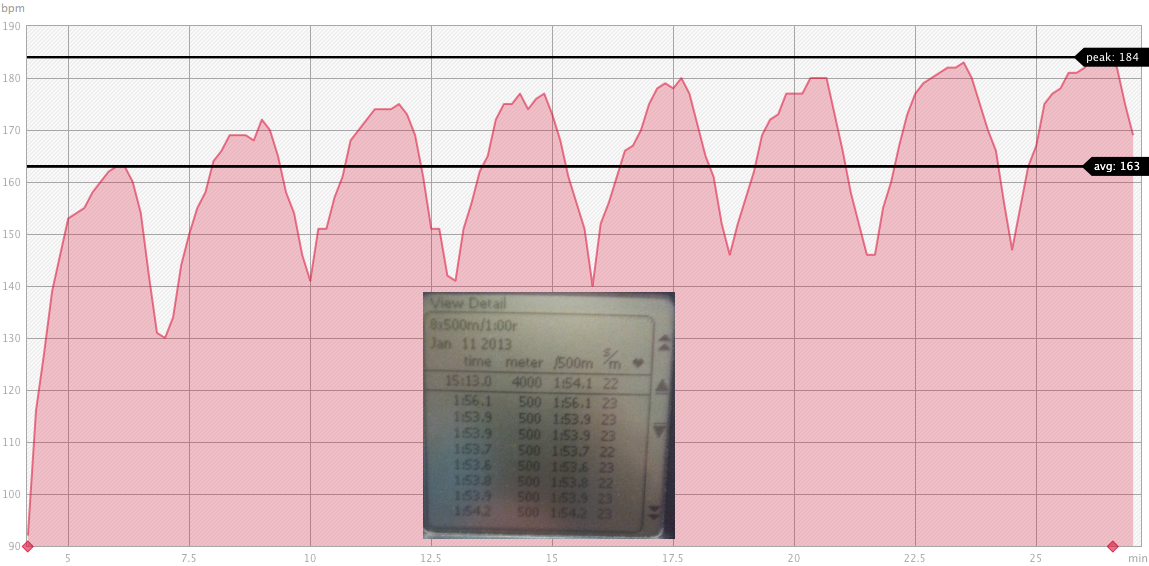
Here are the session readouts, just to prove I'm doing it. I always do a 500m warm up and 500m cool down (easy), with rollering and stretching (plus some glute activation work pre set.) I did miss the first and last split on my 8 x 500s which is annoying, as it was more due to rowing related retardedness than an inability to hit the splits!

8 x 500m - 1 min rest
4 x 1200m - 4 min rest
3 x 2000m - 3 min rest

I'd love to hear how you are all getting on! Any help or advice is welcome!


Wednesday, 9 January 2013

A New Challenge (and a really bad idea?)

So my friend Jeremy, who I participated in Polar Challenge 2011 with, has a new challenge on the horizon - and that its to race around Britain in a boat. Check out the team and their plans here. Unsurprisingly, considering the scale of the task, and his previous rowing experience (none), he has been focused and hitting the gym with dedication and consistency. He often he posts up snapshots of the readout for 60 or 90+ minute rows. While I now think nothing really of a 60 or 90 minute run on trail as something that is difficult, the idea of spending it indoors on an ergo couldn't be more off-putting. I haven't sat on an ergo since 2003, and even then I didn't enjoy it. When I saw the tweets and posts of his efforts, envy was not something I felt.

I would consider myself a goal-oriented individual. I like having goals, I respond well to them, and I certainly enjoy achieving them. That said, the most rewarding ones are not easy. At the moment, physically speaking, although I have a few goals based on hitting certain strength standards and a few races/challenges on the trails scattered over the next year, I have been somewhat lacking in inspiration. Nothing really seems to appeal.

Taking a look at some year totals. It is relatively clear that I've managed to put in some consistent work. (I've only used Movescount since March 2011 so there is some overlap here but it gives a reasonable indication of a rolling 12 month average in March 2012 and now. Excluding the weight training, I think the averages from the year before should be similar too.)

March 2011 - March 2012

Jan 2012 - Jan 2013

Now I've pondered this for a while, and came to the conclusion that until I find something that REALLY grabs me, I should just do something. I also felt I needed to shake things up. I wanted something that was difficult, and something that would be good for me. I don't know why I thought of indoor rowing, but here goes.

So at the moment, it is me vs Jay. The challenge is a 5km ergos. We clocked one this week, and have 12 weeks to improve our times by the most. So starting next week, we have 12 weeks to boost our time. The 'winner' is the one that improves the most. At some point in the first week of April, (if I make it that far) we will both put in another 5km effort.

Now the challenge isn't perfect, Jay has been rowing for a couple of months now, and so within 12 weeks might find it harder to improve. That said, relative to me, he probably still has some gains in his general aerobic capacity to be made. Despite its imperfections, it is a challenge that matches us both.

It will push me mentally, but will also give Jay some added motivation, albeit extrinsic motivation. As we are both in it together it will boost relatedness on the task. We should improve, therefore fostering a sense of competence, and there is certainly NO ONE that is making me do this and so it ticks the autonomy box too. On top of all this, its direct relevance to Jay's circum-GB row, adds meaning (for Jay). For me, the meaning derives mostly from the sense that I can help out a friend. Its also bit of curiosity - Have I still 'got it?' - namely, is my general apathy toward tasks that once appealed a sign of a deeper change? It should also definitely add noticeable boost to my threshold fitness, so mental jiggery-pokery aside, should serve to benefit my wider athletic goals.

Jay's first attempt - 08/01/2013

My first attempt - 09/01/13

Having posted my initial 5km effort this morning, I am even more intrigued by the task ahead. As I walked to the gym I was not looking forward to the effort. My fears were quickly realised as I definitely didn't enjoy it. I also massively regretted doing no threshold/Vo2 work over the last couple of months. I think JFK had it right though when he said that we choose to do these things...

...not because they are easy, but because they are hard.


I will do no more than 3 sessions a week as I wish to work on my other goals concurrently, but won't disallow Jay from doing more should he so wish.  Hopefully I can use my training nouse and experience to 'out-improve' him, but at the end of the day, it is a challenge with an outcome that is beneficial and positive for both of us. That said,  I'll certainly be dusting off the old POWERbreathe. Game face on!!

I tweeted about the challenge before I did my session this morning and a club member commented on the task:


It reminded me of an interview I read about Morgan Spurlock who on recalling when he came up with the idea for "Super Size Me" a friend had commented:

"that sounds like a really great, bad idea!"

If this goes anything like I remember the film, it could be an interesting 12 weeks. Hopefully it won't involve vomiting, the general onset of organ failure or any other long term risks to our health!

Friday, 30 November 2012

Piece of String Fun Run - Unravelling the paradox

I've been holding back my opinion on this race for a while now, partly because as usual, I hadn't really made up my mind about it. If you haven't got anything useful to say......;-)

However, some of the recent discussions and race reports from the event itself have given my ideas a bit of context. I thought perhaps that now might be a good time to get them down. As a very poor analogy, I suppose my aim of this blog is to unravel and straighten out the this conceptual 'piece of string' through the medium of my theoretical knowledge of sport psychology. Lets hope the collective mass of my theoretical approach is greater than that of a piece of string! (for reference check out the below video - a funny little link included at the end of Mimi Anderson's report on the race - I love Stewart Lee).


The Concept

So if you are interested enough to have read this far, you will know what the concept of the race is. If you don't, here is a link to the race description. In short, it is a race where the end point is not known. The theory behind this, as discussed by James in his pre-event blog, is that this format will:

  1. reduce certainty, thereby inducing anxiety and hinder performance
  2. undermine the credibility or confidence in ant given pacing strategy
  3. disarm the influence of any beneficial outcome motivation (i.e. 'only x more miles to go!!!')
In addition, there was also an:

     4.  application process 

where applicants had to submit a detailed explanation for 'Why you are qualified to run this race' including a photo of you at your most miserable/worst. 

The Paradox

For the reasons detailed below however,  I think that the race turned out to be a different beast than perhaps first intended.

1. Did the race actually reduce certainty? 

Granted, competitors would not have known the precise end point but I would go as far as to say that it was relatively clear the race was going to be of the 'ultra' variety. Although this doesn't narrow it down too much, it probably puts it in the realm of somewhere between 50-150 miles. Taking into consideration the calibre of the field and the their athletic résumés, you might also assume that it could be towards to the top end of this. (I appreciate this is very easy to say in hindsight - and I could well be wrong). On a more practical point, I felt another giveaway was the clear effort and dedication put into the race by the race directors (RDs). For all accounts they put on a fantastic race - but let's face it, after all that effort, how funny would it actually have been if it was just a 5km or 500m?

From a more technical perspective, removing all certainty of the end point could theoretically assist by removing an unnecessary distraction. If you don't know when the end is, it cannot lead you from the task at hand (or at least it shouldn't!). In a competitive sense, what often separates winners from losers is the ability to stay in the present and focus on what they can actually do in that moment, rather than speculate what might happen in the future (Moran & Kremer, 2008) - I'll talk about how much this matters (or doesn't really) later on.  But in short, such a format I think should actually help the competitors to focus on the controllables. That said, just by removing the end point doesn't mean people will necessarily focus on what they can control. You still have to decide to concentrate!

It seems relatively clear that in this instance, the more successful attempts at this race were in part helped by the more elite navigation skills. Based on Mimi's report, tricky navigation at times resulted in a slower pace and the difficulty of staying warm and eventual withdrawal. Sam also seemed to have had these problems, but at times when he used his Garmin, he showed marked improvements subjective evaluation of his performance at these times. Wouter seemed to be able to use a map well. Effective navigation in this event was one of the only things that competitors could control - it seems like those that did it better.....did better.

2. Pacing and wider strategies

Here is a quote from the FAQs:

"We don’t expect people to run the trails like Ian Sharman but neither do we want people ambling around at 2mph. You will be informed along the way how “close” you are to cut-offs."

This I feel was another indicator about the length of the race. Take into account the terrain in the area, and start from a 2mph cut off and you have a very rough estimation of how far you might have to run. Research conducted by Sam and James Elson gives some insight into pacing strategies at the SDW100 over such distances, but it is clear that the strategies are not homogenous. Another piece Sam did on the Western states also indicates that there is no clear cut answer to pacing anyway.   I feel here that the format again,  can only serve to remove something else that you might else 'worry' about. I don't know if anyone did it, but a good way to gather feedback on pacing would have been to go really slowly (and wear loads of clothes!), the race organisers would then inform you that you were close to the cut offs. Simply move a little quicker for a short while and then when you felt like it, slow down again, until warned. This way you wouldn't be going any faster than you really needed to. In a race with no finishing times, this seems like a good way to promote longevity. 

Another quote from the race description:

"All the rules of pacing, nutrition and mental focus will go out the window in a race where you just don’t know how long you have left to go"

Let's not throw the baby out with the bath water - I'm not sure how or why the fundamentals of mental focus would go out the window, nor the principles of nutrition if we can assume its going to be an ultra? 

3. Outcome motivation

This comes back to the assumption that the end (lets call it the 'end concept') is one of the major motivating factors factors for ultra runners. This is a really complicated topic and ties in with a whole load of stuff.  The fact remains that motivation is a personal construct and removing the end concept will mean different things to different people. I think that in this context, that it is an idea of overstated importance (feel free to disagree - and I would be interested to see any research on this in ultra runners - how many actually predominantly hold onto the thought of finishing as their true source of motivation?).

If I were to classify this in as general sense as possible I would describe the idea of the end concept as an extrinsic form of motivation, albeit one that is very recognisable and familiar. Extrinsic motivators do not play as significant role in self-determination as intrinsic factors, and so I think here that removal of such a motivator probably won't/didn't/shouldn't have had that dramatic an effect. Just because something is familiar or obviously noticeable, doesn't confer significance.  It all comes back to the old, what people think they do and what they actually do being different things. That said, remember its personal, as different situational and personal characteristics mix and collide, entirely different reactions and thought patterns can surface! 

Yoinked from http://runningduo.blogspot.co.uk - i hope you don't mind!

Humans are also quite an adaptable bunch. When something doesn't quite cut it, they'll grab on to something else. Rasmus Henning talks a little about his 'motivational pyramid' here, the two main points being that forms of extrinsic motivation (e.g. money) only goes so far,  and depending on the situation he'll focus on another motivating factor to get him through a training session, or race. Sam's experience at the Piece of String fits with nicely he cited one of his reasons for pushing on was:


I found this pretty unusual. If you are to look at the motivation continuum (this was the shortest most succinct explanation I could find) Sam's reason above sits somewhere between external or introjected regulation, and is certainly not what you'd expect. More classically, you might imagine he'd have said: 

"When all is bleak and lost - I just carry on in order to go on experiencing the fundamental joys of the running experience, nothing else matters"

But in Sam's case, he cites a main motivator as an extrinsic factor, not specifically driving his wife bonkers, but more insinuates that he uses how he WOULD have felt if he had quit.

 In line with Self-Determination Theory (Deci & Ryan, 1985, 2002) this isn't thought to foster self-determination. Moreover, using Need for Achievement Theory (Atkinson 1974; McClelland 1961; McClelland et al. 1953) it suggests avoidance failure (as opposed to striving for success) which is associated with low achievers. Further still, its a form of emotion-focused coping, not problem focused coping. The latter is associated with confidence, and in turn, persistence. The former is not. Theoretically, I might argue that the end concept, although motivating in some ways, could also work against you through distraction. The term 'arrival syndrome' sums it up quite well - although its great to stop and smell the roses once in a while and revel in your achievements, doing it too much (or before you've got there!) can distract you from doing the very things that will get you there in the first place!

So how the hell did Sam finish, having turned the rule book on his head in using such an 'off-piste' motivator? I don't know. Is there something about ultra running, that having run yourself into the ground, under extreme fatigue and impaired cognitive function that makes more simplistic recognisable motivators (albeit extrinsic) more potent? Is it an adaptive mechanism as a function of the weird race format? In the absence of the finish line being a motivator, did he just use other extrinsic factors in their place. Possibly, it would be interesting to know if Sam always uses this as his prime motivator. Perhaps it just goes to show that under extreme circumstances, there really are no rules. Or maybe, if you have an extrinsic motivator as powerful as 'the wife' - a man might need nothing more  ;-)

4. The application process and applicants

I think if anything this was something I didn't like but could see why it was there. I didn't like it because it felt almost elitist, and on first glance seemed to promote or was at least centered around ideas of an 'achievement' culture (I briefly discussed these in my last blog). I've certainly never liked to think of ultra running as a meritocracy.

I do however understand how the application process fits within the concept of the race. If you were going to put on a ridiculously difficult  race, as a race director you'd probably want to ensure that the participants could at least look after themselves! I think there is a collective responsibility of those in the endurance running community however, not to espouse the message that 'what you do says anything about who you are'. I think its something that is often misconstrued when we get lost in discussions of races and experiences past. Encouragingly though, I'd also like to say that its seems relatively obvious to me the position of the race organisers:

"The exact distance, finishing times and awards are all irrelevant here."

Its really refreshing to see this in an event!

I also couldn't think of a better example that undermines the idea of such an achievement culture. What better way to disprove the idea that past achievements count for anything than by selecting a field of high-achieving individuals and seeing how they do in extremely purified form of competition. 2 from 10 finished.  With a skewed competitor pool, selected for insane acts of persistance and 'mental toughness', might one not assume that you'd get a higher finishing rate than 2 from 10? Taking this further, you also might expect that if the race was really hard, the finishers would be the more decorated of individuals than those that didn't, which wasn't the case (although this experiment doesn't really tell you much when the whole field are high achievers - you would need some ultra runners with no track record to say anything about that!).

If we could agree however. that they've mostly all completed 'harder' or 'tougher' races, and the difficulty wasn't a limiting factor, then surely the difference between those that finished and those that didn't must come from somewhere else? This all ties into another blog by James about whether its always the same people that finish. I could disagree - and sit on the fence and say 'it depends'. Obviously there is a multitude of other factors to consider when looking at performance in an inaugural and novel ultra such as this - but this is neither the time nor the place!

N.B. for all those who are shouting in disgust at the computer screen having read the above two paragraphs and other sentences throughout, please understand I am merely attempting to probe at the conceptual limitations of the race and playing devil's advocate. I don't necessarily subscribe to any or all of the points I put forward....or do I?!?!?

Anyway, I'm sure the RDs have received plenty of suggestions for improvement, but for a true psychological experiement,  my suggestion would be to send out a questionnaire profiling the would-be applicants against an inventory of skills. Then, individually give participants a race format that challenges their individual psychological 'shortcomings'. I should turn out a bit like that bit Bill and Ted - a bogus journey....


In terms of research, I would have also personally loved to have seen the applications of the competitors - a thematic analysis of how these type of athletes value themselves would be very revealing! In developing their own personal hell....;-)

Conclusions

So while I think that the concept has its limitations, doesn't everything? Even though it didn't necessarily turn out as planned perhaps from a psychological perspective, that is not to say that it wasn't a success, nor that we can learn from it! By their nature 'experiments' rarely tend to give the results that are expected, and if they do, be suspicious!

It seems like the race has turned out almost a bit like a CPD workshop for ultra runners. In tweaking the rules, I'm sure it has given those involved a lot to think on. From an outsider looking in, if nothing else, it seems like it might have tested a few of the less well practiced but clearly crucial skills that every ultra -runner should have. Maps Schmaps! ;-)

What I personally also like about it is that is a great example of how someone from within the community can take an idea like this and contribute in a worthwhile way. It serves as a valuable reminder that its not just about racing, but that any investment of time (whether its organising, volunteering, or crewing, participating or even just talking) can be equally valuable in the wider context.  I personally am looking forward to seeing this event evolve and all that it brings with it. It is obviously also important to recognise the tireless efforts of James Elson. Its been said before but the fact that he managed to safely host 2 races in spite of the conditions is nothing short of remarkable. The community is lucky to have such an excellent character (and team of people) out there organising great events throughout the year.  Thanks guys!

Again, all comments and thoughts welcome.....


Wednesday, 21 November 2012

Achievement motivation in ultra running, ironman and endurance sport

I've not written a blog in a while, and for the masses that are wondering what happened in Transalpine 2012 after my last post - I'm going to be lazy and refer you to Lotte's race report (part 1 and part 2) :-)

The seed for this post was actually planted during my participation Transalpine this year, and relates to that of achievement motivation in endurance sport. Its a topic that I have been chewing over for a while now, and even after extensive thought, I'm still not sure I've got to the bottom of it. Anyway, here goes:

What first appealed to me about endurance events (ultras, marathons, ironmans etc) is that to just to finish was an achievement. The battle to be had was with the race itself. Not that there isn't a competitive aspect to every "race", but there was fundamentally something welcoming and encouraging about the fact that my performance wasn't going to compared so much with my competitors (a competitive climate) but with myself (a mastery climate).

The fact I, (and many others) have been drawn to this aspect of endurance sport isn't surprising. There is research to suggest that mastery climate fosters task involvement, where persistence, and personal improvement are rewarded. In competitive climates however, only the best prosper and it can be an extremely debilitating environment for those who are less able.

According to Nicholls' (1984) Achievement Goal Theory, there are two basic stable personality orientations: task or ego-oriented. The former prefers to participate in a given activity more for the opportunity for self-improvement, whilst the latter head out and like measure success relative to those directly around him/her. Although this is a somewhat simplified description of the theory, I think its enough to go by. Cury et al. (1997) showed how task-oriented people are far more likely to select challenging tasks so that they have the opportunity to assess their development that they have achieved through persistence. It follows, that those who tend to participate in endurance events, are likely to be task-oriented the scraps of research that have been conducted on the topic would seem to point in this direction also; Krouse et al. (2011) found that female ultra runners had a tendency to be task-oriented.

MICRO

Now not to get too far into this, but musings have led me to consider the bigger picture. I believe within each race (lets call this the micro-level) a mastery climate is more or less predominates. On any given day, while the ego-oriented amongst us are free to look at just how far up the 2nd from last page or results they came, most will contextualize their performance relative to their personal goals, reminisce and head home. Only a small percentage really seem to care that much about how they did relative to others, and thats perfectly ok.

MACRO

When you zoom out a little, I think the mastery climate is somewhat diminished. People naturally begin to compare between races (lets call this the macro-level). You get all the talk of the toughest, the hardest, the longest etc. (a blog post in its own!)  In doing so, I don't think its unfair to say that maybe what an individual has achieved say in a less difficult race, might often be overshadowed by more 'impressive' achievements, even amongst those in the know! Personally however, I like to think I value some of my less notable achievements far more than some of the more "impressive" ones.  A good example of this came up at a recent race I attended. During the race briefing, the organiser spent a few moments welcoming the group, then went on to specifically mention a few of the more outstanding achievements of the competitors toeing the start line. I'm all for celebrating success and was it inspiring? Sure. Also, was it important to recognise the influential names who's opinions might help define the success of the event in future years? Definitely. But I can't help but think what those taking part in their first ultra may have thought when the goliath challenge ahead of them was effectively devalued amidst the trans-national and trans-contienental accolades of their very immediate others. It reminded me of animal farm a little actually.....

"All ultra runners are equal, but some are more equal than others"  

Ok, maybe that was a bit far, but hopefully you get the jist? Now there was no negative intent at all in the organiser's words, quite the opposite, but I think it shows how when you look at more than just one race, the aspects of a competitive climate begins to surface. Needless to say, this comparison of races is a bit of a pet-peeve of mine, and something that I think is kind of missing the point! (but thats just my opinion - each to their own).

META

The final level it made me consider was the contrast between those who participate in endurance sport and those that don't participate at all (let's call it the meta level). Here, I think the balance between the mastery/competitive climate is heavily in favour of the latter. Even though all your mates  might ride 100 miles every weekend, get up at 5.30am to go running all the time, or train 15 hours a week, you are in the minority.  I suppose it feels like a collective narcissism of sorts, where it the 'why' and 'how' of what you do are lost, and people 'looking in' only see the number....... 26.2, 112, 50, 100.....

I've tried to conceptualise the three layers below. Red denotes a competitive climate, and blue a mastery climate. The Micro-levels are the races, where the mastery climate predominates. In the context of this environment, for the most part, the task-oriented can thrive and prosper. As you begin to look at the broader picture and the wider endurance scene, denoted by the pill shaped area - the competitive climate starts to make itself known. Here the substance and value of personal goals can be lost amongst someone who has gone harder, faster and longer.  Finally, at the meta-level, where those that do and those that don't are compared, the entire world of endurance sport is nearly enveloped, where what you do, seems to start to say something about who you are.


As far as I can tell, I'm task-oriented, which might explain why the comparative nature of the ego-oriented types, and their influence on the endurance environment bothers me a little. This post didn't turn out how I expected it to, and its pretty loose on the ground in terms of theory. It's certainly not watertight and I've not even really touched upon achievement motivation in competition - a pretty relevant topic. I've more tried to explain my perspective (very crudely) of how the dynamics of competitive and mastery climates interact in different contexts within in endurance sport.

If you want to test whether you are task or ego oriented you can do so here. Doesn't mean much on its own, but might explain why its important to you that came 655th NOT 656th in your Age-group.....in the 12th wave.....on the Saturday, not the Sunday......

I hope you enjoyed reading, and welcome all comments.

Thursday, 30 August 2012

Final Preparations - The Gore-tex Transalpine Run 2012

So the final preparations are more or less complete, and somehow, against all odds, Lotte and I will seem to be on course to toe the start line in Ruhpolding in a 2 days time. Training this year has gone well, more so for myself than Lotte, who was hampered by a couple of issues (back and foot) post Roth. Despite this, we have got in a good amount of running together at the weekends with Lotte coping well with the consistent running.

For myself, after 7 days complete rest post-Roth, I've managed to get back into the swing of things pretty quickly. I've got to the gym for 1-2 hours each week which keeps things ticking over nicely, and got through approx. a 15 hour week of running with no niggles of note. The last couple of weeks, I've focused on consolidating that bigger week and staying supple (by my standards). I've had a couple of massages and things are looking good. I think its funny when you put the time spent training in the context of the race, which this year I estimate might take up to 50 hours; the larger volume week (week 4 - approx. 90 miles) is completely dwarfed.


Transalpine run-in, and predicted run 2012
 I feel I've managed my recovery well since Roth too. I did nothing for a week, and despite a wobble at the end of July (stag-do for a friend), I've managed to get enough rest to prevent major deterioration. As you can see, having rested up this week, I'm now feeling pretty good heading into the weekend.

Restwise score - Roth to Transalpine
Compare this approach from 2011, where after running the NDW (week 4) and pulling out due to a knee issue, I did very little approaching the race. Wise to rest up perhaps, but I've certainly noticed I run best when carrying a little more consistency and form into a run. That said, almost anything can happen in stage race of this proportion, so I guess we'll have to wait and see as to whether my approach has paid off. In 2010 I completed the race off just 18, 25 and 30 miles in the 3 weeks leading into the race, so maybe its actually really easy and you don't need to do any training at all ;-)

Transalpine run-in 2011
In addition to the higher volume I've managed this year, I've complemented my training with my POWERbreathe device. I'd like to say I've really gone to town on the functional strength work whilst using it over the last 6 weeks, but in reality, I've just made sure I kept things ticking over. With only a couple days work a week (morning and evening sessions 30 breaths, twice daily) I've easily managed to sustain the level I reached from my foundation training before Roth. Its encouraging to see that the gains I made have stuck, and are so easy to maintain.  Although everyone is different, for me, anything above 2,200m seems pretty noticeable, so I'm looking forward to the benefits that the POWERbreathe training should bring with it.

I can't wait to get back out there, and as there is a good group of us going out together, there will undoubtedly be some good memories to remember for several years to come.

The photo below is from part of the route on stage 7, and a view I remember well. Its also been my desktop background since 2010. Let's hope the weather is just as good when I return (hopefully), with Lotte (hopefully) Saturday week!


If you want to follow us during the race, please go to http://www.transalpine-run.com/alps_cross_start.htm and they have pretty good coverage of each stage! We are Team POWERbreathe UK - number 90!